
The Czech German Shepherd is not a different breed of German Shepherd; there is only one breed standard (see this page 👉 The standard) and it should not be confused with the Czechoslovakian wolfdog.
It originally referred to a working livestock farming tradition developed in ancient times Czechoslovakia, particularly around the famous program of the Pohraniční stráž, the Czechoslovak border guard.
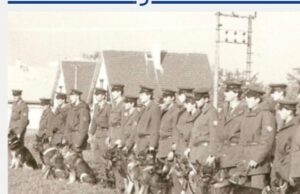
To understand what is now called a "Czech lineage", we must therefore go back a few decades.
Dogs selected for real work
From the 1950s onwards, Czechoslovakia set up a major breeding program to supply dogs to its border guard services.

The state kennel z Pohraniční stráže was established in 1955 and the breeding program was officially established the following year.
These dogs are not selected to participate in a sporting competition. They must be able to work for long hours, follow a scent, search for a person, work in difficult conditions and, if necessary, act with strength.

The selection process therefore emphasizes physical strength, nerves, endurance and work ethic, but also defensive and guarding qualities.
This is a fundamental difference for understanding the subsequent evolution of these lineages.

The dog we are looking for is not simply an animal that likes to work: it is a dog capable of dealing with a real situation.
Czech Republic and East Germany: Similar Histories
The selection programs of Czechoslovakia and East Germany have many similarities.
The selection takes place in countries of the Eastern bloc, with significant needs for service dogs.
Czechoslovakian bloodlines also widely use dogs from the former East Germany to create their own line. To learn more about DDR bloodlines, read the article here 👉 German Shepherd GDR, myths and reality

Thus, among the old Czech and DDR families, we often find similar characteristics (and common ancestors): solid bone structure, significant pigmentation, robust construction, endurance and serious temperament.

But the two populations will then follow their own evolution.
That is why it is more accurate today to speak of families and lineages than to consider "Czech" and "GDR" as two perfectly homogeneous types.

After the fall of the wall
The fall of the Iron Curtain in 1989 profoundly altered the breeding of the German Shepherd in Central Europe.
The old working lines are becoming accessible to breeders and private users. They are gradually starting to be exported, particularly to Western Europe and the United States.
At the same time, some of the Czech lines will be crossed with working lines selected for sport or utility; often Czech (or DDR) blood is integrated in order to bring back size and toughness, and vice versa.

This development is important: A dog with Czech origins is not necessarily today a faithful representative of the old German Shepherd of the Border Guard.
Some pedigrees have retained a high proportion of the old working lines. Others have gradually incorporated sporting lines; the needs of users necessitate an adaptation of the bloodlines.
The label "Czech" is therefore not enough on its own to know the dog.
Jinopo and the preservation of old families
Among the most interesting players in this modern story is Jinopo, a group of Czech breeders.
Jinopo's work, particularly around Jiří Novotný, former head of the z Pohraniční stráže program, sought to preserve an important part of this genetic and behavioral heritage.

The goal was not simply to preserve a color, morphology, or pedigree.
The aim was to maintain a versatile working dog, physically and mentally strong, with a balance between the different behavioral drivers.
This is one of the reasons why old Czech families are particularly interesting for users looking for a dog with instincts different from those exclusively geared towards sport.
Of course, even within Jinopo, and following the evolution of needs, the characters of the dogs have also evolved.
Czech German Shepherd and Predation
This is probably where the most interesting difference lies between some old Czech bloodlines and modern sporting bloodlines.
To simplify, we can distinguish several behavioral drivers in working dogs: Nose or trail, predation, defense and guarding – we will return to these topics in detail in future articles..
Of course, these behaviors are not independent switches, and their expression depends on many factors. But selection can favor certain components over others.
In certain modern sporting lineages, selection has progressively and extremely favored the lever predation. (On this topic, also read 👉Prey instinct in modern lineages )
The dog must be crazy about the ball, crazy about the sausage, running, chasing, grabbing, pulling, starting again; he works for the object, more than to satisfy his master or because he would understand what is happening.

For IGP or ring sport, and certain utility training, this motivation is obviously extremely useful.
But taken to extremes, this selection can lead to a dog whose reaction to work is essentially triggered by the object and by the predatory game.
Defense and guarding instincts can then become much less present.
And that is precisely where certain Czech and DDR lineages retain something truly different.
A genuine ability to read situations
This is probably what strikes users most who are used to very modern sporty lines.
The traditional Czech dog, like the DDR (East German) dog for that matter, may seem less demonstrative.

He is clearly less obsessed with the ball or the object, and responds less naturally to conditioning.
But when a situation arises in the real world, we are amazed to see his ability to become alert based on his pure instincts.
It should also be noted that a dog of ancient Czech or DDR lineage can be unsettling for a trainer accustomed to modern "In Drive" techniques (see here). 👉or wanting to compete in sports. We are very far from the Malinois that bite the web at 8 weeks old, and it is not unusual to see this type of dog not fully awake until 8-12 months!
In conclusion, besides the historical aspect, the true interest of the old Czech bloodlines perhaps lies in a particular philosophy of selection: to produce a dog capable of working, but also capable of understanding when and why it needs to work.
This genetic pool of pure instincts is also of particular interest to breeders seeking to preserve or rediscover this type of characteristic in their lines.

If this topic interested you, also read... Comparison of lines , History of the breed
The German Shepherd | Health | Selection | Living with a German Shepherd | Education and training | Photos | Links | Articles and Reflections


